
GRID SHIELD: ACTIVE DEFENSE INFRASTRUCTURE
Strategic Architecture for Distributed Infrastructural Resilience
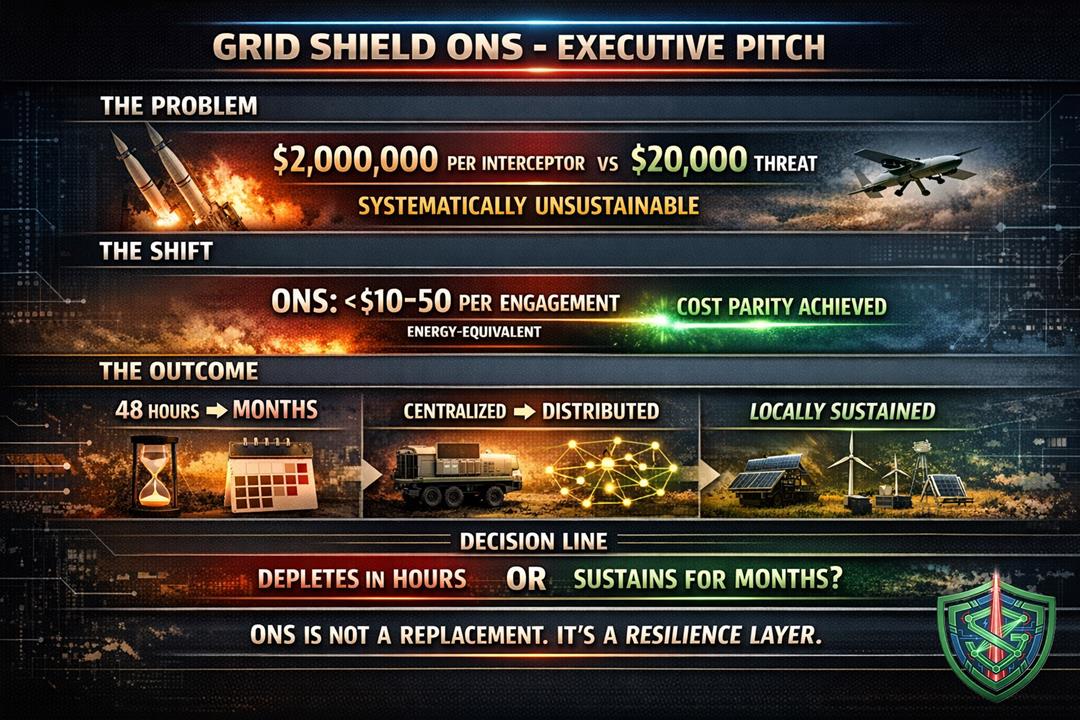
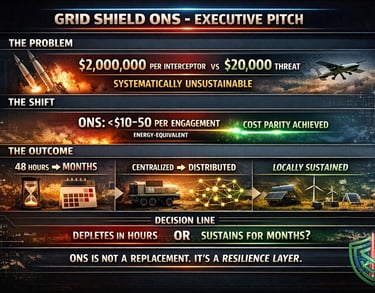
Data based on internal estimates as of 20.02.2026. Individual results may vary.
Grid Shield ONS
The Problem
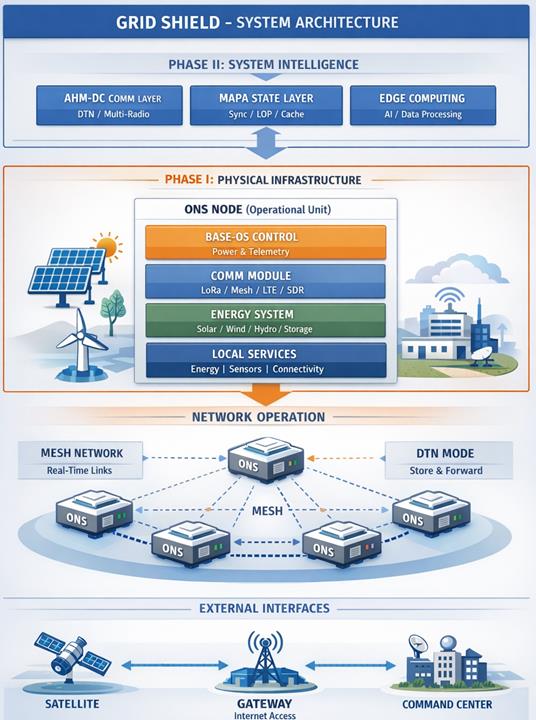
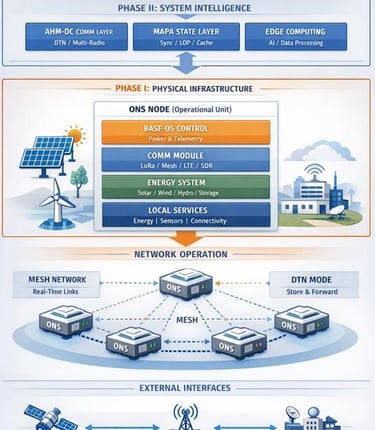
Modern defense and civil systems rely on centralized infrastructure.
Under saturation, disruption, or logistics breakdown, these systems degrade — not because they are weak, but because they are concentrated. When infrastructure fails, operational capability follows.
Transitioning from Centralized Vulnerability to Decentralized Persistence.
Strategic Architecture for National Resilience. Operational Continuity in Contested Environments
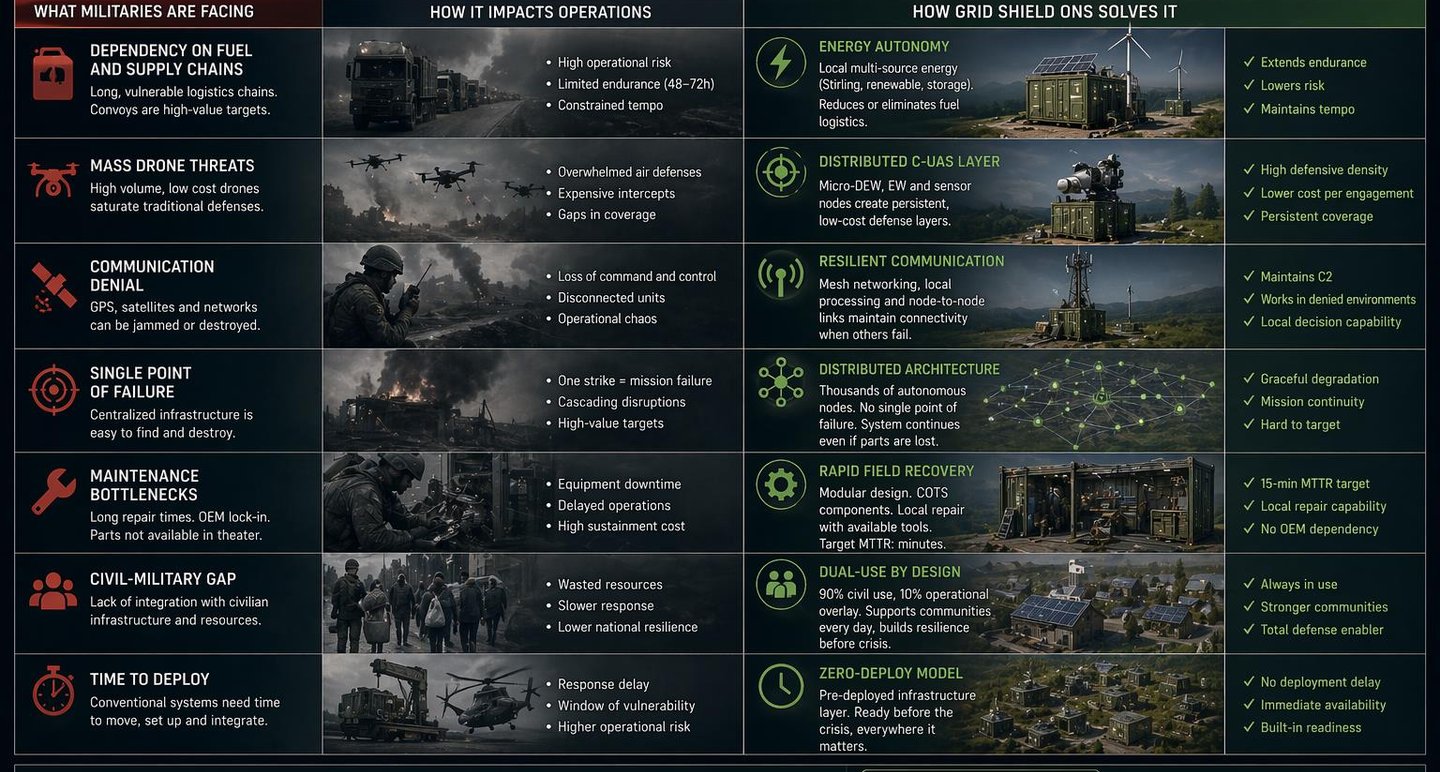
GRID SHIELD ONS introduces a distributed layer of Autonomous Infrastructure Units — a resilient operational fabric that ensures mission persistence when centralized grids and logistics fail.
The Core Premise: We do not just build hardware; we deploy a decentralized "Internet of Energy and Defense" that recalibrates the cost of national security.
The Solution: Distributed Operational Fabric
Instead of relying on vulnerable, centralized hubs, GRID SHIELD creates a high-density network of modular nodes.
How to Think About It: The "Virtual Garrison"
Decentralized Power: Not one central plant, but hundreds of autonomous energy-generation units.
Infrastructure-as-a-Service: Each node acts as a micro-base, providing energy, connectivity, and life support directly in the field.
Immediate Availability: Energy, communication, and logistical support are already in place—wherever the node is deployed (forests, borders, mountains).
Deploying the ONS Standard for Immediate Infrastructural Resilience.
Implementing the ONS Framework to Mitigate Attrition Bankruptcy and Logistical Dependency in Contested Environments.
Core Capabilities & Technical Rigor
Energy Autonomy (Resource Neutrality)
Multi-source energy generation (Stirling-cycle, Hydro, Wind) combined with Hydrogen synthesis eliminates the "tyranny of fuel tankers" and reduces POL dependency by up to 80%.
Operational Continuity (Fractionated Resilience)
The system maintains 100% functionality of the remaining matrix even under partial infrastructure loss or kinetic fragmentation.
Rapid Regeneration (High Maintainability)
Engineered with a 15-minute MTTR (Mean Time To Repair) using standardized, commercially available components and 3D-printing compatibility.
Distributed Support Layer
Persistent, autonomous support for:
Unmanned Systems (UAV/UGV): Automated recharging and battery-swap hubs.
C4ISR Networks: Hardened, CEMA-proof mesh communication backbones.
Field Operations: Power-bus for Directed Energy Weapons (DEW) and life support.
Stirling Engine Generator diagram. Vector. Device that receives energy from thermodynamic cycles. Clean, alternative energy. High-efficiency machine with high temperature differences.
Operational Role: The Force Multiplier
GRID SHIELD does not replace existing defense systems — it ensures they survive. It provides the "Foundation Layer" that keeps high-value assets operational when the primary infrastructure is degraded or destroyed.
Strategic Use Cases:
Border Integrity: Maintaining 24/7 surveillance during total power and network blackouts.
Autonomous Hubs: Supporting UAV swarms and loitering munitions without centralized bases.
Logistical Independence: Enabling long-term field operations without reliance on vulnerable fuel supply chains.
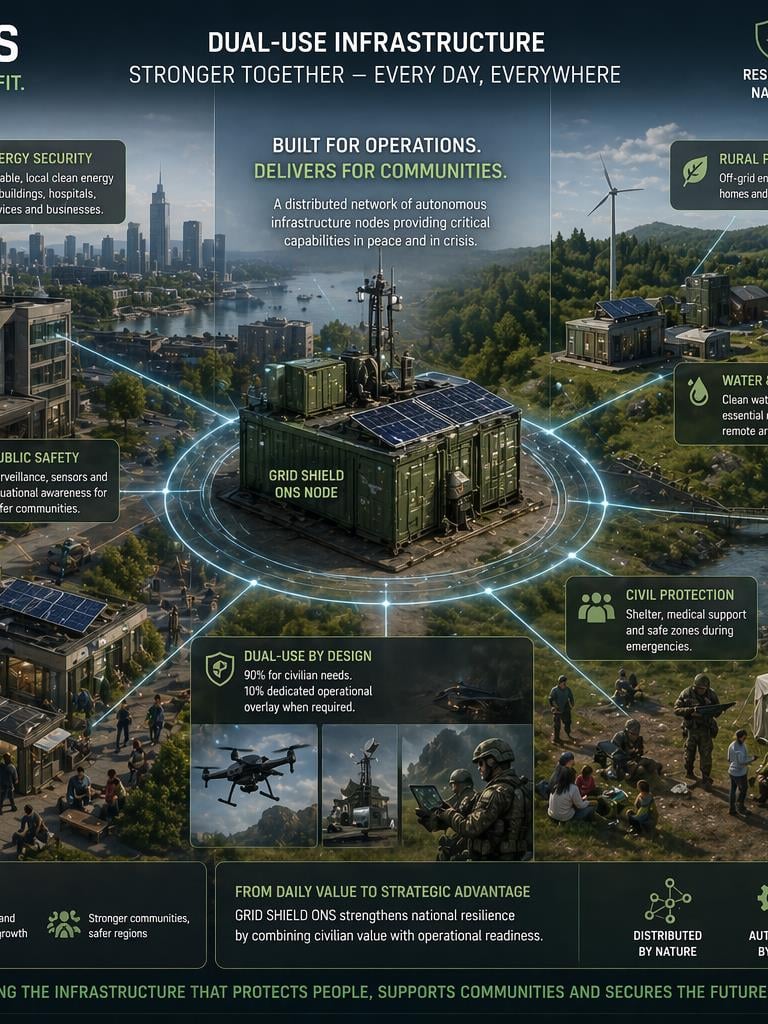
Civil-Military Continuity: Protecting critical civilian infrastructure while providing a "Military Overlay" for active defense.
Technical Benchmarks
Architecture: ONS (Operational Node Standard) v1.4
Power Density: 15–50 kW Modular Units
Signature: <45 dB Acoustic / Mitigated Thermal IR
Readiness: TRL 7 (System prototype demonstration in operational environment)
GRID SHIELD: Strategic Distributed Infrastructure
National Resilience Through Autonomous Operational Continuity
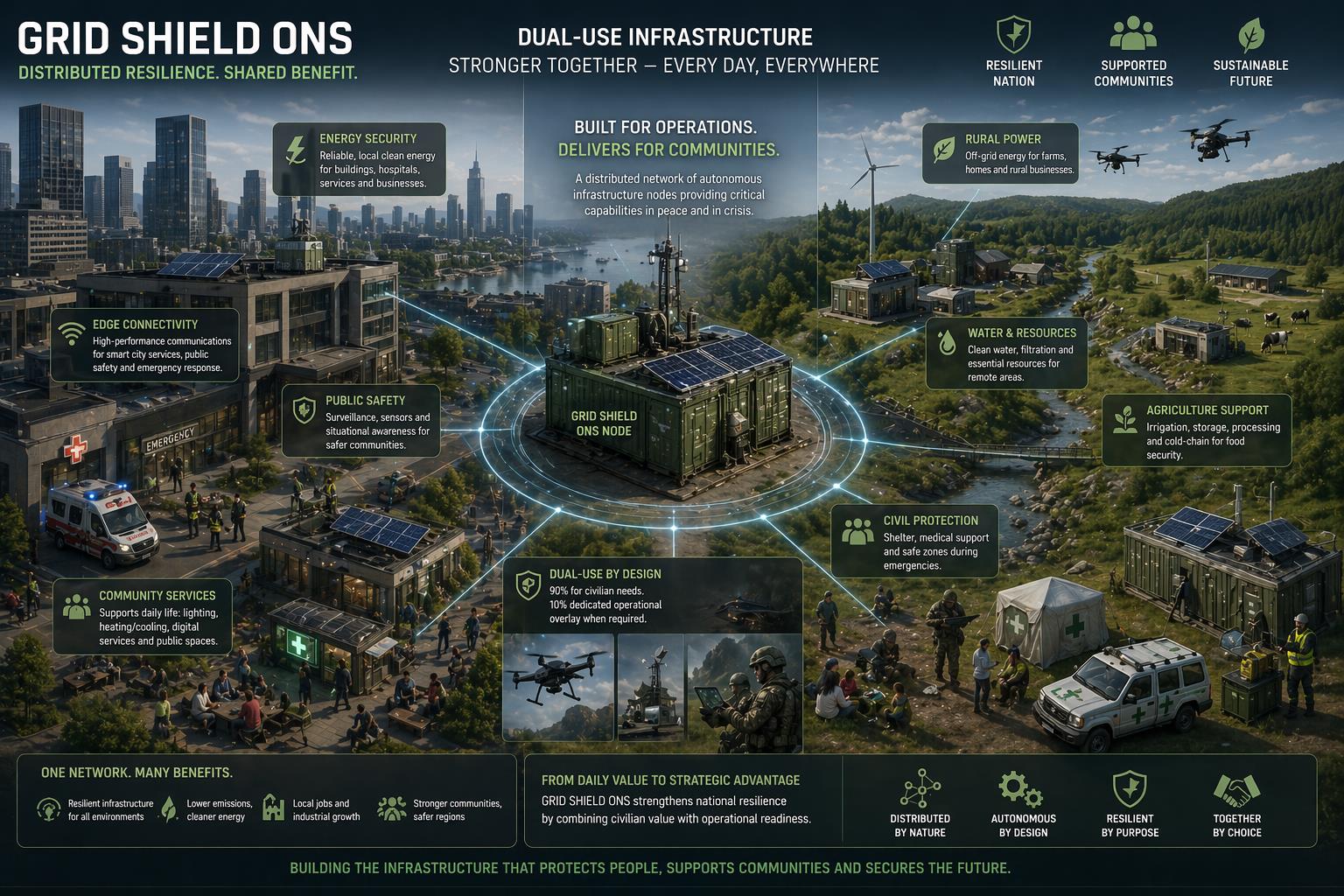
GRID SHIELD is a distributed infrastructure framework designed to maintain operational continuity under degraded conditions. Instead of relying on vulnerable centralized systems, we distribute energy, computation, and support functions across a hardened network of autonomous units: The ONS Nodes.
I. THE SOLUTION: Distributed Operational Fabric
This is not just another base. This is a network of hundreds of autonomous micro-infrastructure units.
GRID SHIELD creates a resilient operational "fabric" distributed across the national territory. Each node acts as an independent micro-base capable of operating solo or as part of a coordinated, self-healing network.
Virtual Garrison Logic: Hundreds of autonomous points of presence replace single, high-value targets.
Infrastructure-as-a-Service: Energy, connectivity, and logistical support are pre-positioned exactly where they are needed—in forests, borders, and remote terrain.
Active Defense Integration: GRID SHIELD does not replace existing systems; it provides the survival layer that keeps them operational when primary infrastructure is compromised.
II. CORE CAPABILITIES: The "Gold" Standards
Five pillars defining the next era of national resilience.
1. Distributed Energy & Resource Autonomy
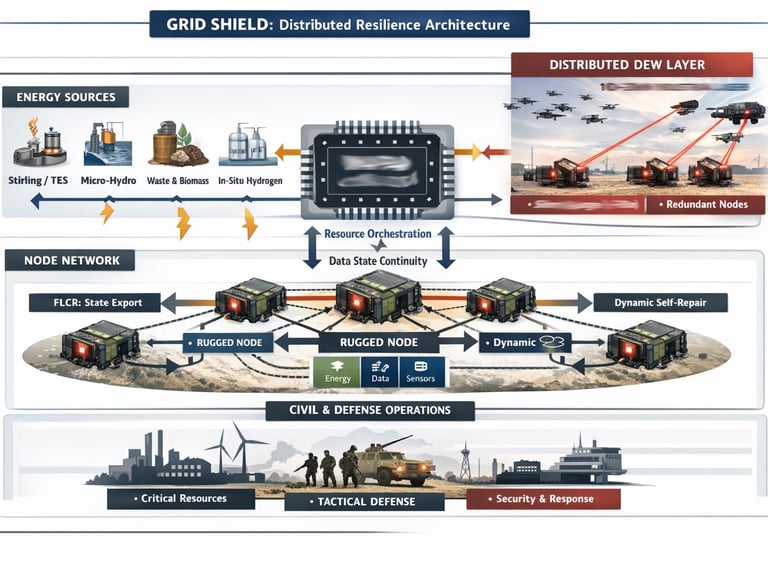
Localized multi-source generation (Stirling-cycle, Hydro, Wind) supported by In-Situ Hydrogen (H2) Synthesis.
POL Independence: Reduces fossil fuel logistical dependency by 60–80%.
Energy Islanding: Sustains 100% functionality even during total national grid blackouts.
2. Edge Computing & Local Intelligence
Localized data processing without reliance on cloud-based or centralized server farms.
Decision Autonomy: Each node manages its own survival and mission parameters, ensuring resilience against strategic communication failure.
CEMA-Resilient Mesh: A distributed backbone designed to withstand Electronic Warfare and Contested Spectrum environments.
3. Repair-Centric Design (FLCR Model)
Engineered for Rapid Regeneration rather than costly, long-lead replacement.
15-minute MTTR: Modular architecture allows for field repairs measured in minutes, not days.
No OEM Lock-in: Local repairability using standardized industrial components and 3D-printing compatibility.
4. Resilience Logic: Non-Linear Survival
A system that "lives" despite kinetic or cyber damage.
No Single Point of Failure: The neutralization of one node only degrades the matrix by 1/n of total capacity.
Graceful Degradation: The architecture prioritizes critical availability over peak efficiency to ensure survival in the most degraded environments.
5. Dual-Use Operational Model
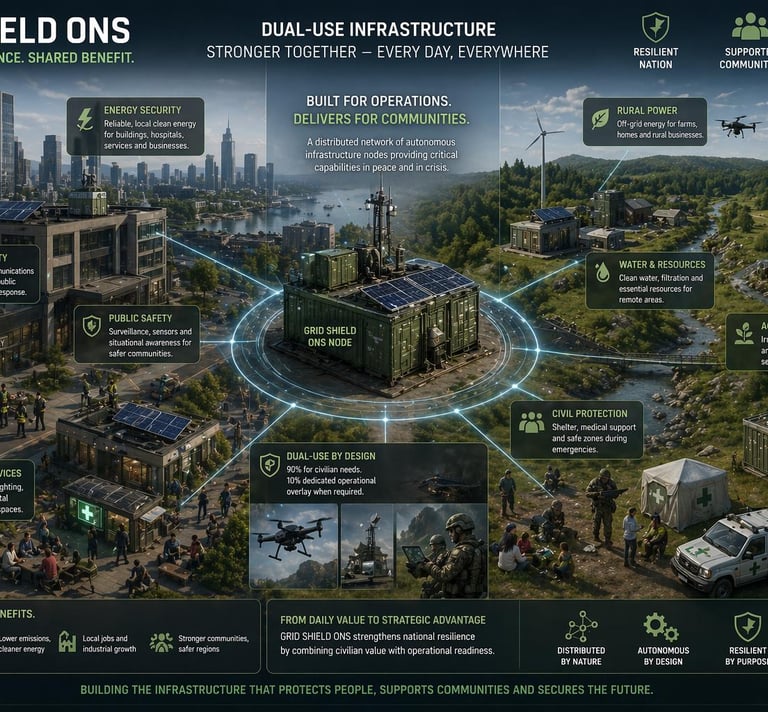
90% of system components operate daily within the civilian sector (agriculture, industry).
Zero "Dead Capital": Infrastructure remains productive during peacetime, ensuring 95% combat readiness without maintenance rot.
Target Discrimination: Mass civilian deployment creates "background noise," masking military modules from adversary ISR.
Pillar: Active Airspace Resilience Layer (CEMA & HPM Support)
Enhancing infrastructure survivability under high-density UAS activity. GRID SHIELD integrates distributed electromagnetic support capabilities into its node architecture, enabling localized airspace resilience in environments affected by high-volume unmanned systems (UAS). The system is designed to reduce engagement pressure on kinetic defense assets by introducing a scalable, energy-based support layer.
1. Distributed Electromagnetic Disruption (HPM Support)
GRID SHIELD nodes may incorporate High-Power Microwave (HPM) modules to support non-kinetic disruption of small unmanned systems.
Non-Kinetic Interference: Wide-area electromagnetic effects may degrade onboard electronics, sensors, and communication links within the engagement envelope.
Swarm Mitigation: Particularly relevant in high-density scenarios, where single-target systems may face saturation.
Area Effect: Supports area-level interference, reducing the reliability of UAS autonomous flight controllers.
2. Energy-Based Engagement Efficiency (ONS Power Layer)
The ONS architecture provides access to buffered, distributed energy sources, enabling pulsed electromagnetic systems without reliance on dedicated fuel logistics.
Buffered Pulsed Power: Local energy buffers (battery / thermal / hydrogen) support short-duration high-power output required for HPM discharge.
Logistical Persistence: Eliminates dependency on continuous fuel supply chains for defense systems.
Economic Parity: Improves cost-efficiency in high-volume engagement scenarios by utilizing localized environmental energy.
3. Distributed CEMA Environment (Signal Layer)
GRID SHIELD introduces a multi-node electromagnetic environment designed to affect adversary sensing and targeting reliability.
Signal Granulation: Distributed emitters create non-uniform RF conditions across the operational area, complicating adversary SIGINT efforts.
Link Degradation: May reduce GNSS reliability and C2 link stability for autonomous systems in contested spectrum conditions.
Signature Management: Lower individual node emissions reduce exposure to anti-radiation targeting compared to centralized high-power jammers.
Pillar: Signature Management & Stealth Logistics
Achieving Operational Invisibility via Subterranean Integration and Resource Autonomy. The GRID SHIELD architecture fundamentally redefines infrastructure survivability by minimizing physical, thermal, and electromagnetic signatures across the entire operational lifecycle. We replace detectable supply chains with hardened, autonomous nodes.
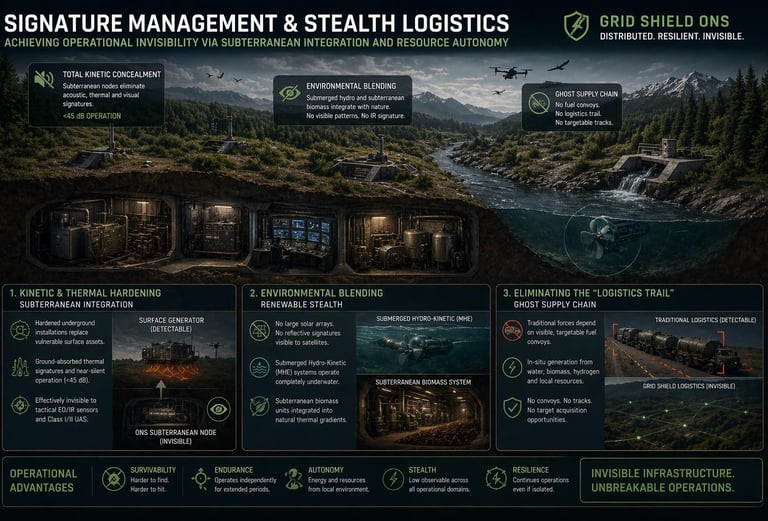
1. Kinetic & Thermal Hardening (Subterranean Integration)
The Diesel Alternative: Unlike conventional Diesel-Electric Generators (DEG) that produce high-intensity acoustic and thermal plumes on the surface, ONS nodes are hardened, subterranean installations.
The Result: Total kinetic concealment. Ground-absorbed thermal signatures and near-silent operation (<45 dB) render the node effectively invisible to tactical EO/IR sensors and Class I/II UAS reconnaissance.
2. Environmental Blending (Renewable Stealth)
Beyond Visible PV Panels: Large-scale solar arrays are easily detectable via satellite due to unique spectral reflections. GRID SHIELD prioritizes Submerged Hydro-Kinetic (MHE) and Subterranean Biomass systems.
Invisibility: Hydro-turbines operate completely submerged and out of sight in riverbeds, while biomass units are integrated into existing underground thermal gradients, removing all predictable visual patterns of centralized energy parks.
3. Eliminating the "Logistics Trail" (Ghost Supply Chain)
Fuel Decoupling: Traditional military units depend on a visible, targetable trail of fuel tankers and supply convoys—the primary targets in high-intensity conflicts.
In-Situ Generation: By generating energy from local resources (Water, Biomass, Hydrogen), we eliminate the requirement for persistent fuel resupply.
Tactical Advantage: No convoys mean no visual, acoustic, or thermal "tracks" leading to operational positions. GRID SHIELD disconnects the infrastructure from the enemy's target acquisition cycle.
Contact
Technical documentation and system architecture details are restricted to verified Government and Defence representatives.
Telefon
contact@grid-shield.eu
+48 574 708 889
© 2026. All rights reserved.