
What Problem It Solves
Centralized infrastructure fails under saturation, disruption, or logistics collapse.
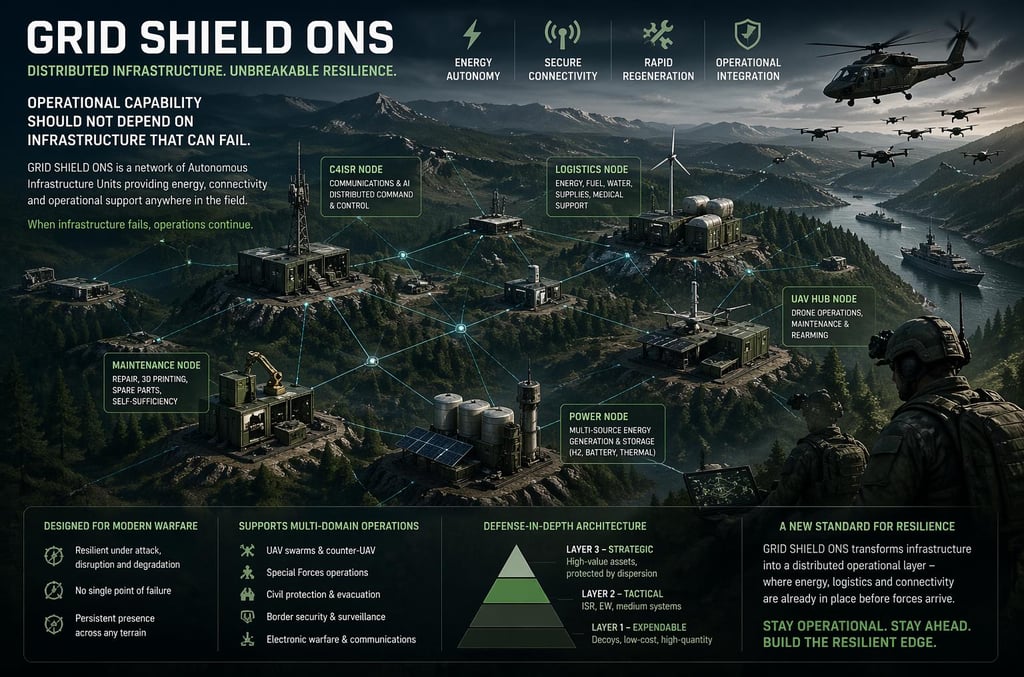
GRID SHIELD preserves operational continuity when those systems degrade. Does not replace military systems. It ensures they continue to operate when infrastructure fails.
ONS Fractionated Base Architecture
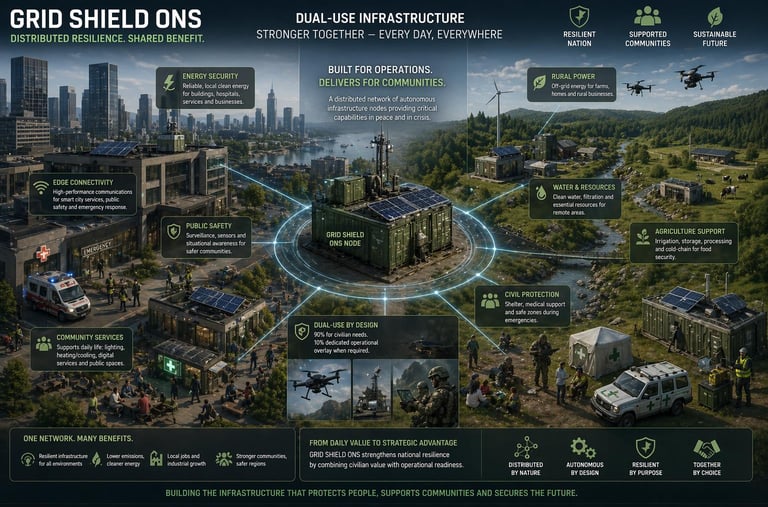
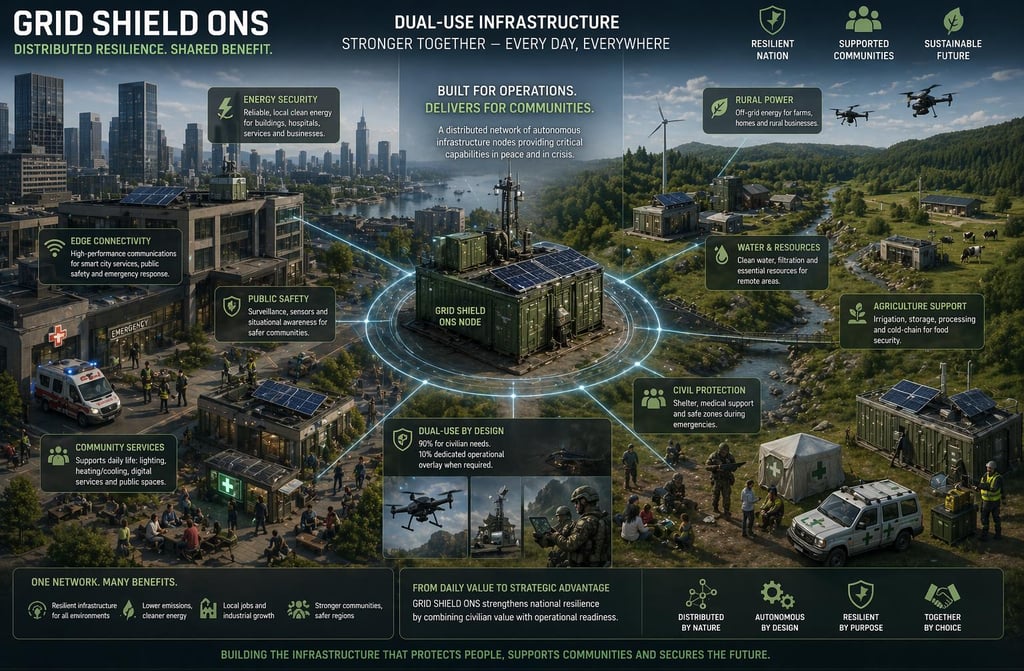
A distributed network of Autonomous Infrastructure Units
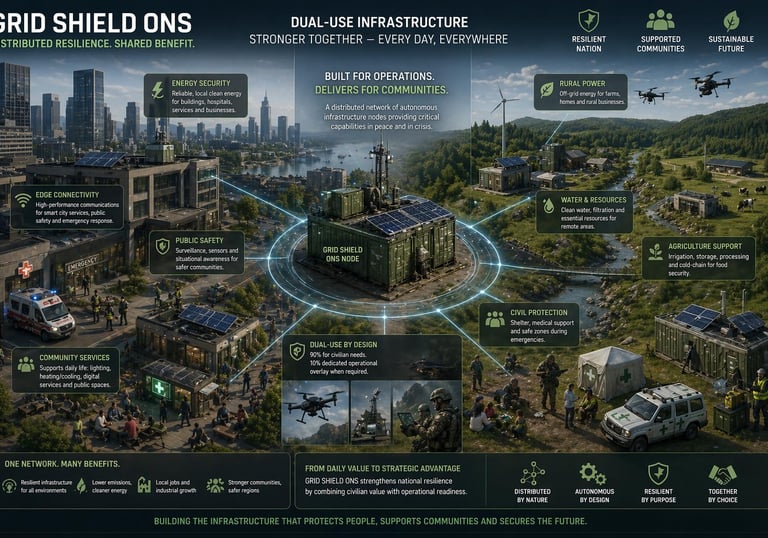
Core Capabilities
1. Energy Autonomy
Local generation (renewables, thermal, storage)
→ no fuel dependency
2. Distributed Continuity
Nodes operate even if network is partially destroyed
→ system survives fragmentation
3. Rapid Regeneration
COTS-based, repairable locally
→ no waiting for military supply chains
4. Operational Integration
Acts as:
drone docking network
communication backbone
forward logistics layer
Border surveillance continuity under power loss
UAV swarm defense support via distributed energy nodes
Civilian evacuation support with autonomous energy hubs
Special forces operating without logistics tail
Example Use Cases
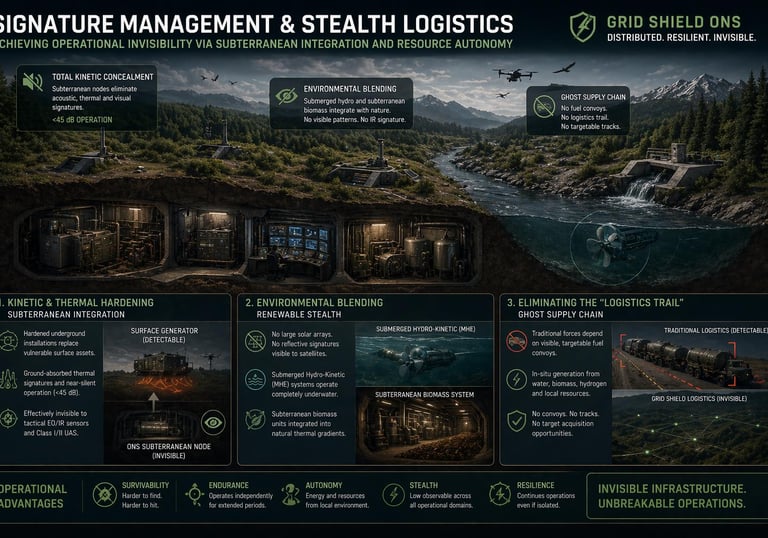
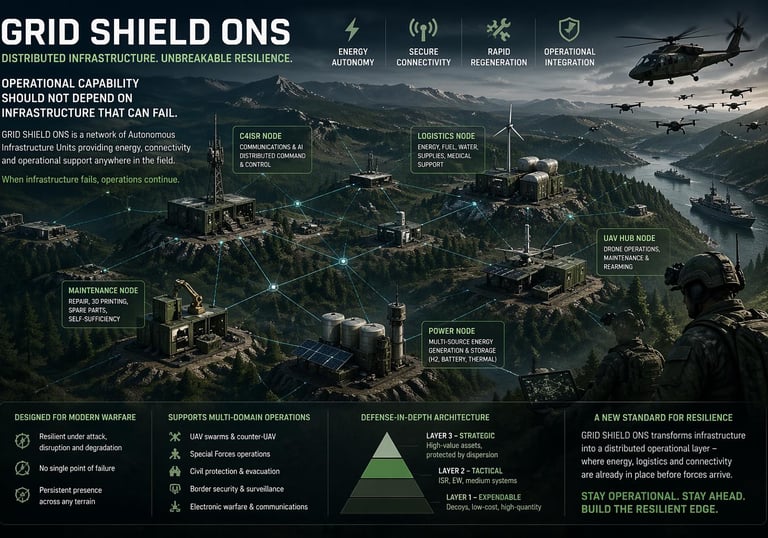
Each node functions as a micro-base, providing:
energy
data
logistics support
independently or as part of a network.
How to Think About It
Instead of one large base, you have hundreds of small, autonomous ones distributed across the terrain.
energy is already in the field
communication is already in the field
logistics is already in the field
No deployment delay. No single point of failure.
GRID SHIELD transforms infrastructure into a distributed operational support layer — where energy, logistics, and communication are already present in the field before forces arrive.
“Gear Shield establishes a system that maintains operational continuity when traditional logistics fail.
DTPP is not inventory—it is the capability to regenerate function in real time.
It provides sovereign resilience where conventional infrastructure ends.”
RESILIENT COMMUNICATION LAYER (AHM-DC)
Distributed Communication for Degraded and Denied Environments
The AHM-DC system is a distributed communication layer designed to maintain data exchange under conditions of degraded, intermittent, or unavailable infrastructure.
It combines mesh networking, delay-tolerant data transfer, and multi-radio communication into a unified operational framework.
The system does not assume continuous connectivity.
It is designed to operate when connectivity is limited or absent.
CORE FUNCTION
AHM-DC enables data exchange across distributed nodes using adaptive routing and opportunistic transmission.
Mesh-based local communication between nodes
Store-and-forward data transfer (Delay-Tolerant Networking)
Automatic selection of available communication channels (LoRa, WiFi, LTE, Satellite)
Local data storage and synchronization when connectivity becomes available
Result:
Data flow is maintained even under partial or intermittent connectivity conditions.
OPERATIONAL DESIGN PRINCIPLE
Traditional communication systems rely on stable infrastructure and continuous links.
AHM-DC operates under the opposite assumption:
Connectivity is intermittent, degraded, or unavailable.
The system adapts by:
Storing data locally when transmission is not possible
Forwarding data when a connection becomes available
Utilizing mobile or opportunistic links as part of the network
EDGE PROCESSING CAPABILITY
Each node provides localized data processing to reduce transmission load and improve responsiveness.
Data filtering and compression at node level
Transmission of processed outputs instead of raw data
Reduced dependency on centralized processing infrastructure
Effect:
Lower bandwidth requirements and improved operational autonomy.
SYSTEM ARCHITECTURE (HIGH-LEVEL)
Multi-radio communication nodes (LoRa / sub-GHz / WiFi / LTE / Satellite)
Adaptive mesh routing with link-quality evaluation
Delay-Tolerant Networking (DTN) layer (store–carry–forward)
Local data caching and replication
Edge computing layer for local processing
Gateway nodes for external network integration
The architecture is modular and scalable.
Nodes can operate independently or as part of a distributed network.
OPERATIONAL EFFECT
The system supports:
Continuity of communication under infrastructure degradation
Data persistence during communication outages
Reduced reliance on centralized communication nodes
Increased resilience to electronic interference and network disruption
USE CASES
Operations in denied or degraded communication environments
Infrastructure disruption (blackout, disaster scenarios)
Remote or off-grid deployments
Distributed sensor and reconnaissance networks
Civil-military integrated communication layers
INTEGRATION ROLE
AHM-DC serves as a distributed communication backbone for GRID SHIELD ONS nodes.
It enables coordination, data exchange, and system-level continuity across the network under degraded conditions.
KEY PRINCIPLE
“Communication is treated as an intermittent resource, not a guaranteed condition.”
SUMMARY
AHM-DC is a distributed communication system designed to maintain functional data exchange in environments where conventional networks fail.
It prioritizes continuity, adaptability, and resilience over bandwidth and latency optimization.
GEAR SHIELD: Dynamic Field Production Shield (DFPS)
DTPP Module: Distributed Micro-Manufacturing & Resource Sovereignty Framework
In scenarios of systemic isolation or supply chain collapse, centralized logistics infrastructure becomes both vulnerable and rapidly degraded. Gear Shield replaces traditional stockpiling with distributed production capability, enabled by Digital Knowledge Libraries (Digital Inventory).
Operational Definition
The DTPP module is an integrated subsystem designed for the rapid restoration of operational capability through local production, repair, and adaptation of critical equipment within a target window of ≤15 minutes (Level I systems).
The system is based on three core layers:
Digital Inventory: Secure repository of CAD/CAM schematics, engineering data, and technical models
Procedural Engineering: Field-executable workflows for production and repair
Minimal Toolsets: Standardized fabrication equipment and modular raw material bases
LEVEL III: System Sustainment (R&D Controlled Environment)
Critical system maintenance components
Infrastructure support modules
High-precision engineering subsystems
Status: RESEARCH & DEVELOPMENT – subject to validation and controlled deployment
Technical Foundation: Minimal Production Kit
The system operates on a standardized hardware baseline designed for degraded and austere environments:
Fabrication Tools: Engineering-grade additive manufacturing systems, manual presses, modular forming tools
Material Base: High-durability polymers and universal semi-finished stock materials
Design Doctrine: Every procedure includes fallback substitution pathways for material and tool degradation scenarios
Strategic Role within GRID SHIELD
The DTPP module functions as an integrated resilience layer:
Field Repair Layer: Real-time restoration of damaged or degraded equipment
Distributed Logistics Layer: Eliminates dependency on external supply chains through localized production nodes
Survivability Layer: Ensures continuous operational capability under full supply chain disruption scenarios
Economic & Strategic Impact
DTPP shifts operational doctrine from physical stockpiling to production capability sovereignty:
Zero Dead Capital: Eliminates long-term warehousing and obsolescence costs
Logistical Independence: Removes dependency on external supply chains
Distributed Resilience: Knowledge and capability are replicated across the network and cannot be centrally disrupted
Strategic Statement
“Gear Shield establishes a system that maintains operational continuity when traditional logistics fail.
DTPP is not inventory—it is the capability to regenerate function in real time.
It provides sovereign resilience where conventional infrastructure ends.”
Three-Tier Operational Structure (ONS Standard)
LEVEL I: Base Production (Low Risk / High Necessity)
Structural components
Tools and housings
Mechanical filtration systems
Basic modular assemblies
Status: READY – immediate deployment via digital library execution
LEVEL II: Operational Support (Critical Resilience Layer)
Field-adaptive technical support components
Non-certified emergency support tools
Stabilization and adaptation elements
Status: CONDITIONAL – used under degraded supply conditions
Contact
Technical documentation and system architecture details are restricted to verified Government and Defence representatives.
Telefon
contact@grid-shield.eu
+48 574 708 889
© 2026. All rights reserved.